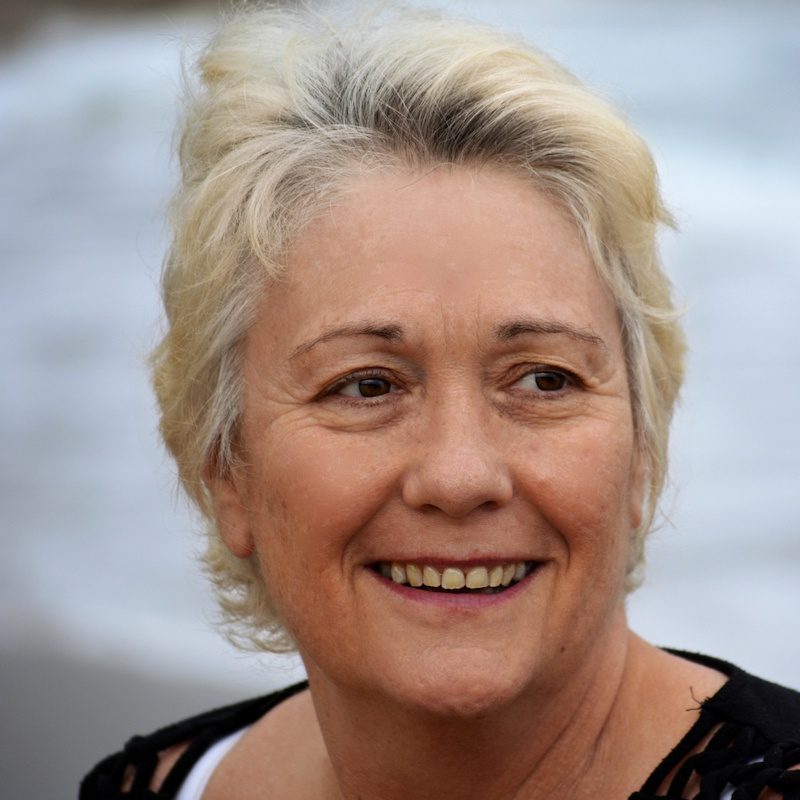

The memory of Sue Clarence was alive in the hearts of stalwarts at the Hilton Arts Festival in KwaZulu-Natal, an event she founded 32 years ago.
Sue died earlier this year after a stroke. She wasn’t always easy, but to those who knew her she was witty and kind. And understated. For someone working in theatre, she wasn’t the clichéd prima donna. She managed the divas backstage.
Sue was remembered at a low-key ceremony at the festival where her family rang a stage bell installed in her honour in the foyer of the Centenary Centre on the Hilton College campus.
The school, based in the KwaZulu-Natal Midlands town of Hilton, hosts the festival but is not connected to the non-profit organisation Sue founded and which runs the event that attracts upwards of 25 000 visitors over three days.
A brief history: Sue and her friend Geoff Thompson, a drama teacher at Hilton, hatched the idea of hosting the event while attending the Grahamstown Arts Festival in 1993.
Sue was miffed when a venue ran short of curry and wine and declared they could do better.
And thus they gave life to what has become a splendid platform for artists, now rivalling the Grahamstown event and showcasing world-class performances.
The jaunty prose of Keith Bain, writing in Daily Maverick last year, captures the mood perfectly.
“The festival also includes art exhibitions, street performances, free music and – to make up for the mid-winter cold – warmth generated by fire pits in the beer tent. It draws people in, gets them huddling and keeps things jovial after dark.
“Apart from the general programme, the festival includes a youth education component called Jongosi. The word was invented for the festival by Johnny Clegg, who took an Afrikaans phrase – ‘jong os’, meaning ‘young ox’, signifying youthful strength and hope for the future – and gave it an isiZulu twist. About 2 000 youngsters attend, do workshops, see shows and might get into conversation with the playwrights and actors afterwards.
“All of it still happens on the grounds of Hilton College, where there are different venues for ticketed shows. A rambling, verdant estate… the school is steeped in bucolic bliss, with tree-lined avenues leading to historic buildings surrounded by vast lawns and lush gardens.”
Poor cousins
This year there were 41 shows involving hundreds of people – performers, lighting and sound technicians, backstage staff and ushers – putting on performances packed to capacity.
Theatre language is trite but often true: delighted audiences (me among them) were spellbound. Most performers utterly commanded the stage with deeply layered characters and clever, thought-provoking scripts about life, death and everything in between.
I mention my standouts to applaud fabulous talent, acknowledge incredible hard work and toast the joy and vitality of these performances: Lisa Bobbert in Ethel; Evan Cullum’s Piano Man; Janna Ramos-Violante in Boys & Girls; John Maytham in To Life With Love; and stand-up comedian Schalk Bezuidenhout. Others raved about a host of shows I didn’t get to see.
Schalk dedicated part of his eye-wateringly funny – and deeply insightful – performance to how casually people dismiss the arts, his livelihood.
Evan Roberts is a co-director of the Hilton Arts Festival and part of a management team that includes Sue’s daughter Julia Clarence, Duncan Bonella and Joanne Hayes.
Reflecting on the festival’s success (ticket sales were up 30% year-on-year), Evan notes that in the economy’s ledger, the arts are often scribbled in the margins – dismissed as frills, a poor cousin to the so-called “serious” engines of growth.
But the arts hum with industry. They employ thousands, spark innovation and drive tourism and investment. It is an ecosystem of carpenters and costume makers, lighting designers and scriptwriters, musicians and marketers – all turning creativity into livelihoods. It’s not “just” entertainment.
It creates beauty, meaning and measurable economic value. A Rhodes University study puts the arts sector at R74 billion a year.
You don’t need to study the arts or be a singer or dancer to understand its impact. Creativity runs from the banal to the sublime – from everyday advertising to the stellar performances at Hilton. It is storytelling all around us.
It is not all flouncy or hyperbolic. It incubates lateral thinking and teaches discipline.
And, in simple parlance, it is a show – and Hilton’s show was spectacular this year.
The festival also hosted 120 crafters selling their wares and 50 food vendors whose offerings were eagerly devoured. It all adds shine to the Midlands Meander, which begins in Hilton and curves 80 km north, encompassing 160 places to eat, drink, sleep, shop and explore – including the historic Nelson Mandela capture site.
Evan notes a marked uptick in visitors from Gauteng, up 20%.
Springboard
“We are becoming a springboard. People come to the festival and extend their stay to explore.
“KZN is a hotbed of creative talent, but it’s short on opportunities. Imagine crafters from deep rural areas doing extraordinary work but having to get to market on their own steam. Often they must pay to trade and don’t even have card machines.
“The uMngeni Municipality and tourism authorities stepped in, mentoring and helping crafters get here, with a huge knock-on effect for the local economy. So it goes way beyond the performers.
“What Sue started 32 years ago with a tent, a trestle table and tea in polystyrene cups is now so much more. The arts are a vital instrument in society. We talk about free speech, but how else do you convey freedom, liberty or humanitarian issues? You do it by writing a book, composing a song or putting on a piece of theatre.”
Actor and director Steven Stead, who directed Boys & Girls, wrote after the festival:
“I have always loved this festival, taking place over a compact and exciting weekend on a beautiful campus surrounded by trees and country vistas. But this one, under a full Sturgeon moon, was special because of the absence of the festival founder, Sue Clarence.
“I was primed to feel her absence, but instead I felt the opposite – her presence. What a legacy she has left. What a gift to KZN and to actors and artists from all over the country. Thank you, Sue, for your vision and fierce love of the arts.”
Julia Clarence says her mother’s presence was deeply felt.
“At first, it was daunting organising the festival during Mom’s illness and after she died, but we felt her guiding light.
“In 2018 she began building a strong team, so there was a succession plan. We were determined to honour her legacy – a platform for talented performers.
“We felt her presence everywhere. It was surreal, like I might bump into her. She was honoured in every conversation. I felt incredibly proud. It was a wonderful success.”
If you can, mark three days in August 2026 in your calendar for next year’s festival. As Hayes put it: “In a time when the world feels divided and disillusioned, Hilton is a space that heals, unites and uplifts… where everyone leaves changed for the better.”
Ernest Hemingway’s For Whom the Bell Tolls reminds us that no one is an island. When the bell rings, it tolls for Sue – and for all of us – to stand up for the arts.