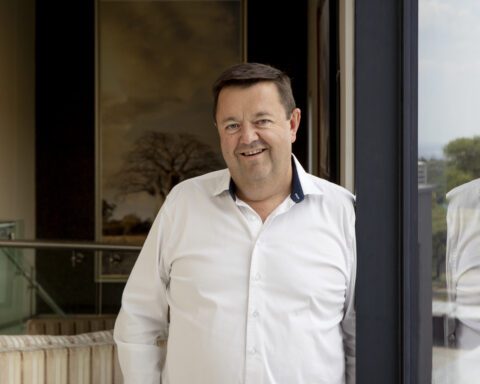
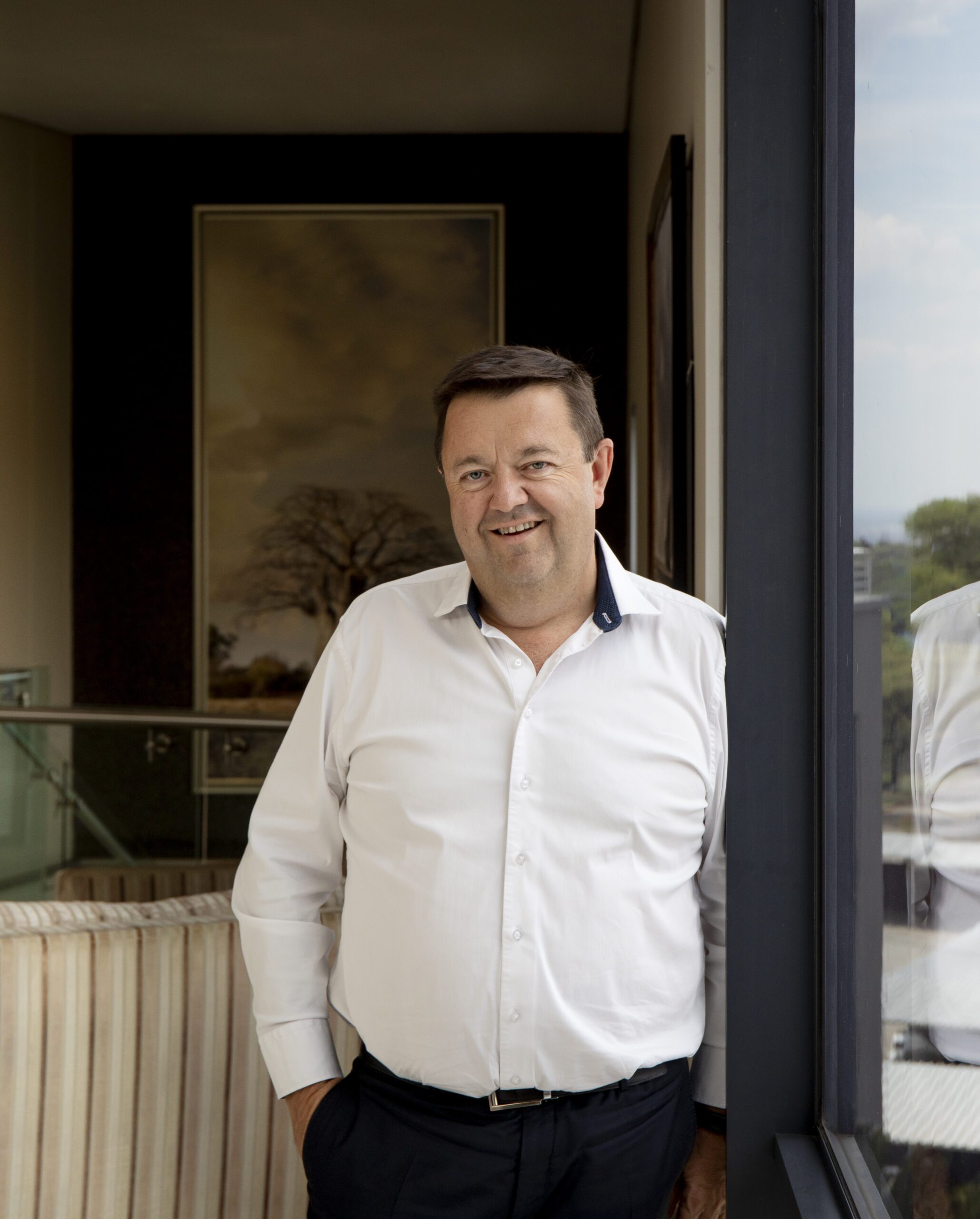

Anchored in grit, Peter Armitage has built a cross-continental business that deals in eye-watering sums of money. But his inspirational success has a modest backstory.
Peter is the CEO of a wealth management company called Anchor Capital. His early childhood was spent in a caravan park in Boksburg. He attended a state school in Durban before earning a scholarship to Michaelhouse. He later put himself through university as a part-time sports reporter before qualifying as a chartered accountant.
After articling at Deloitte, he worked for Deutsche Bank, Nedbank and Investec, and was once rated South Africa’s top investment analyst. A stint at a public relations firm followed, and then an online wildlife-viewing business.
In 2012, he made a game-changing decision.
He spoke to Grindrod chairman Ivan Clark, who invested R2.5 million in Peter’s fledgling Anchor Capital. At the time, Peter was a well-paid analyst with a cushy job at Investec. But he wanted to row his own boat.
He presented the business plan for his wealth management firm to Ivan, who, after 20 minutes, wrote out a cheque for seed funding and took a stake in Anchor.
In five years, Peter grew Anchor from a one-man band into a company listed on the Johannesburg Stock Exchange. In 2017, Anchor was capitalised at R1 billion and managed assets of about R50 billion.
Anchor was delisted in 2020 and merged with British business Credo this year in a deal worth R850 million. The combined companies now manage R250 billion and employ more than 500 people in offices in South Africa, Mauritius and London.
The merged entity is owned by management and minority shareholders (45%), mining magnate Mike Teke (25%) and Capricorn Capital Partners (30%) — the investment firm linked to the billionaire Enthoven family, which owns stakes in Nando’s and Hollard Insurance.
For Peter, the business is about energy, acquisition and expansion. You either grow or you stagnate.
Anchor manages about as much money as PSG or Investec, but it is not a fund, a bank or a traditional asset manager. It is a wealth management business.
“We are closer to the client. We help them design their financial future by investing in different places, locally or offshore. We manage their entire wealth.”
Anchor has about 25,000 clients. The firm works with a network of 250 accounting practices in South Africa to deliver wealth solutions and has a similar arrangement with accountancy practices in the UK.
“Our average client has worked a lifetime to create a bucketful of cash. What he does with that money is probably more consequential for the next generation than all the work he ever did, so it involves massive levels of trust. It is about capital preservation.
“We generally take less risk than a client wants. We convince risk-takers to take less risk and try to persuade risk-averse people to take more. Most people are uncomfortable with volatility, but you must beat inflation to grow money.”
Growing wealth in a fickle world of rapidly changing technology, conflict and volatile politics can be hair-raising. You have to help people understand the power of compounding by being “half investment adviser and half psychologist”.
The best place to make money over time is in equity markets. If a company’s shares are sexy, everybody wants in — which is probably not the best time to buy. Investors are often distracted by share price movements and market volatility, which are not the best measures of a company’s value.
Microsoft might experience share volatility if it changes its CEO, but the company has enjoyed compound annual growth of around 25% over the past decade.
Peter comes alive when talking about spotting winning companies and unpacking their success. His ability to identify a winner distinguishes him as an analyst. Sometimes, it isn’t about having all the answers but asking the right questions.
You do that by investing in growing companies. While Peter is optimistic about South Africa, he is realistic about the country’s development challenges and growth prospects.
Most high-net-worth clients hold anywhere between 30% and 80% of their assets outside rands. A global business best services global investment citizens — hence the Anchor/Credo deal. It offers scale and international investment depth.
For Peter, tapping into the UK market — 35 times the size of South Africa’s — is a no-brainer. A global perspective on wealth management is also critical. Understanding the role of the US in the world economy is vital.
“Big tech and venture capital companies might be domiciled in Europe but choose to list in America. The American market is 65% of the global stock market, but only 25% of the world economy.”
The world’s tech giants are American: Nvidia has a market cap of about $3.5 trillion, Apple $3.4 trillion, Microsoft $3.1 trillion and Alphabet $2 trillion.
Nvidia’s shares are soaring. The company has an effective monopoly on supplying the world’s major tech firms with high-performance graphics processing units and artificial intelligence technology.
Part of Peter’s appeal as a businessman is his pragmatism. Astute and direct, he is not one for hyperbole or hiding the facts.
“We don’t always get it right, and success isn’t guaranteed. This is a challenging business; its ups and downs make it mentally tough. You have to retain faith in your abilities. Our strategy is to invest in growth companies, but sometimes we aren’t successful.”
The 2008 market crash was gruelling. Peter remembers watching money vaporise.
“People worked a lifetime for that money. The phones didn’t stop ringing. Clients wanted out. We told them to stay the course, and the market dropped another 20%.”
But tenacity, honesty and refined investment strategies have paid off.
“Many people moved to us after Covid because their fund managers hadn’t been talking to them and they had lost faith. If you are good in bad times, you grow faster in good times.”
Peter has spent a lifetime exposed to some of South Africa’s most successful entrepreneurs. He rates Stephen Saad, Mark Lamberti, Koos Bekker and Adrian Gore among them.
“Energy is the biggest identifier in my game, and it is the ultimate people’s game. We have no balance sheet. We haven’t patented any intellectual property. We don’t manufacture, import or export anything. All we have is our ability and process to deliver an outcome for a client.”
Growth has helped refine those processes. Managing R5 billion is dramatically different from managing R250 billion.
“I have had to learn to deal with growth. I am at the stage where the people I employ are doing better than me and creating exponentially more value. That’s gratifying to see. Energy, process and culture are important. I am the first person here in the morning. Leaders must set the example for what is acceptable in any business.”
Peter is optimistic about South Africa’s prospects, buoyed by the government of national unity. Fixing the country’s infrastructure does represent a growth opportunity, but it will not quickly solve the deep-rooted challenges that inhibit progress. That is why more affluent South Africans are looking abroad to grow their wealth — many with Anchor.